SysCarb theme
Microbial Enzymes and Nano-Assemblies for Polysaccharide Utilization
A few words
Microbial Enzymes and Nano-Assemblies for Polysaccharide Utilization
Carbohydrates are ubiquitous in all cells in nature and essential to all forms of life. Throughout evolution they have evolve and lead to highly diverse and complex structures due to their chemical composition that play essential roles in our health, diet and are an important resource for the development of renewable energies and biomaterials.
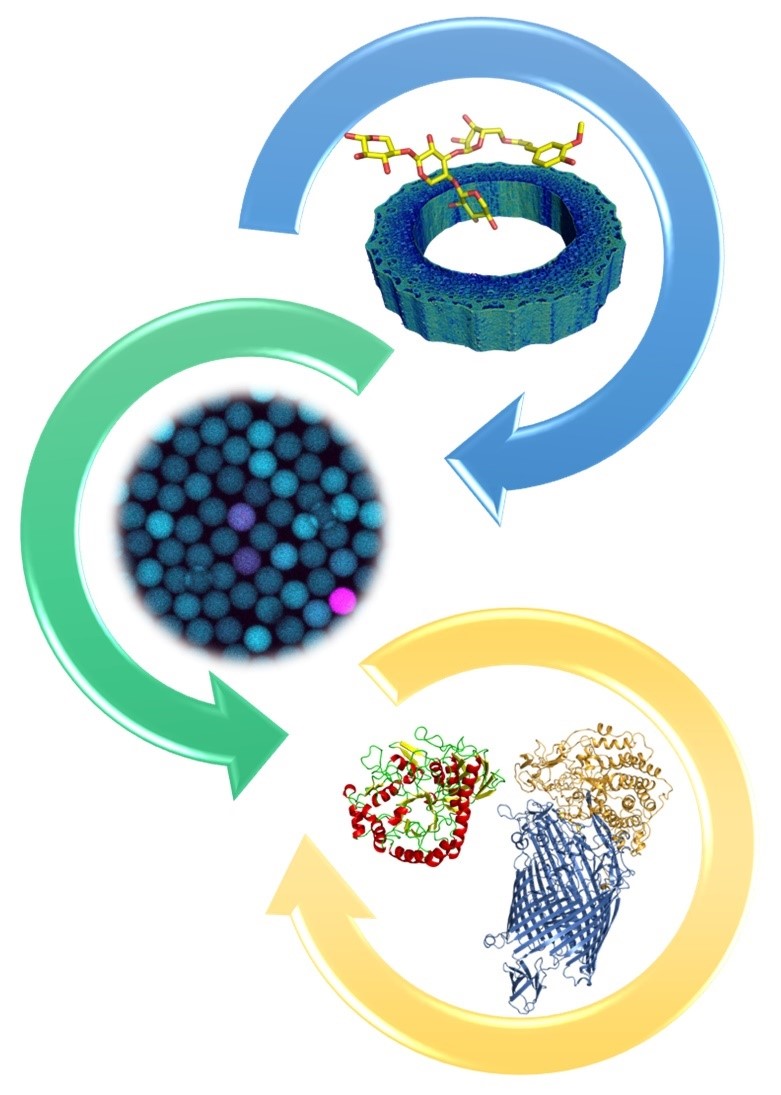
The aim in Sys-Carb axis is to understand how protein systems produced by microorganisms degrade polysaccharides. This involves studying enzymes, multi-protein systems and transporters, constituting the key elements of polysaccharide metabolic pathways.
We are particularly interested in understanding:
- Which microorganisms and enzymes are important in an ecosystem for the degradation of oligo- and polysaccharides?
- What are the molecular determinants of protein-carbohydrate interactions?
- What factors influence enzymatic synergies?
- How do enzymes function in planta ?
- How do post-translational modifications, such as protein glycosylation, contribute to the recognition and hydrolysis of polysaccharides?
Theme coordinator: Claire Dumon
Ongoing projects
Bluetools projects
2023-2027

Bluetools Horizon CL6-2022-CIRBIO
Innovative tools for sustainable exploration of marine microbiomes: towards a circular blue bioeconomy and healthier marine environments
In BLUETOOLS, we explore marine microbiomes for novel enzymes involved in the breakdown of microbial, algal and marine plant polysaccharides. These innovative biocatalysts will be used for the production of oligosaccharides of interest for human health.
CONCERTO
2022-2025
ANR-21-CE43-0024
Controlled spatial prOximity for iNnovating enzymatic Cascades to Enhance biomass deconstRucTiOn
Les enzymes jouent un rôle crucial dans le métabolisme cellulaire. Elles peuvent agir soit individuellement, soit au sein d’organisations complexes ayant des activités catalytiques distinctes. L’hydrolyse complète de la paroi cellulaire végétale nécessite un large éventail d’activités enzymatiques différentes travaillant en synergie sous la forme d’un cocktail d’enzymes libres ou immobilisées sur un complexe multiprotéique lié à la membrane cellulaire externe. Dans cette configuration, on pense que la proximité spatiale et l’orientation du site catalytique sont d’une importance capitale dans l’efficacité particulière du cellulosome dans la dégradation de la biomasse végétale. Concerto a pour objectif d’étudier l’effet de proximité spatiale d’un tel complexe multienzymatique au moyen d’une approche d’ingénierie originale combinant étude enzymatique, structure du complexe en solution et analyse systématique du profil de produit libéré par le complexe. Le projet vise à améliorer notre compréhension de la synergie entre enzymes afin de produire des produits sur mesure à partir de la biomasse complexe.
LABEL
2023-2026
ANR-22-CE43-0012
Conception d’assemblages moléculaires pour évaluer le rôle de la glycosylation sur l’activité d’hémicellulases
Le rôle de la glycosylation des glycoside hydrolases n’est pas bien élucidé, notamment en ce qui concerne les interactions enzyme-substrat et l’effet sur leur activité hydrolytique. En utilisant l’incorporation site-spécifique d’acides aminés non-canoniques et la chimie bioorthogonale, des hémicellulases fluorescentes glycosylées sont préparées et étudiées, notamment en termes d’interactions avec le substrat. Leur potentiel catalytique et de diffusion est évalué au sein de matrices complexes polysaccharidiques mimant la paroi végétale.
BIO4
2021-2024
Ademe
Développement d’un démonstrateur valorisant l’hémicellulose du bois
The BIO4 project "Towards an Innovative Wood Biorefinery" aims to develop a process for extracting and adding value to wood hemicelluloses.
OPTI-ZYME
2023-2027
Ademe
Second-generation PET waste biorecycling process with optimized economic and environmental performance