

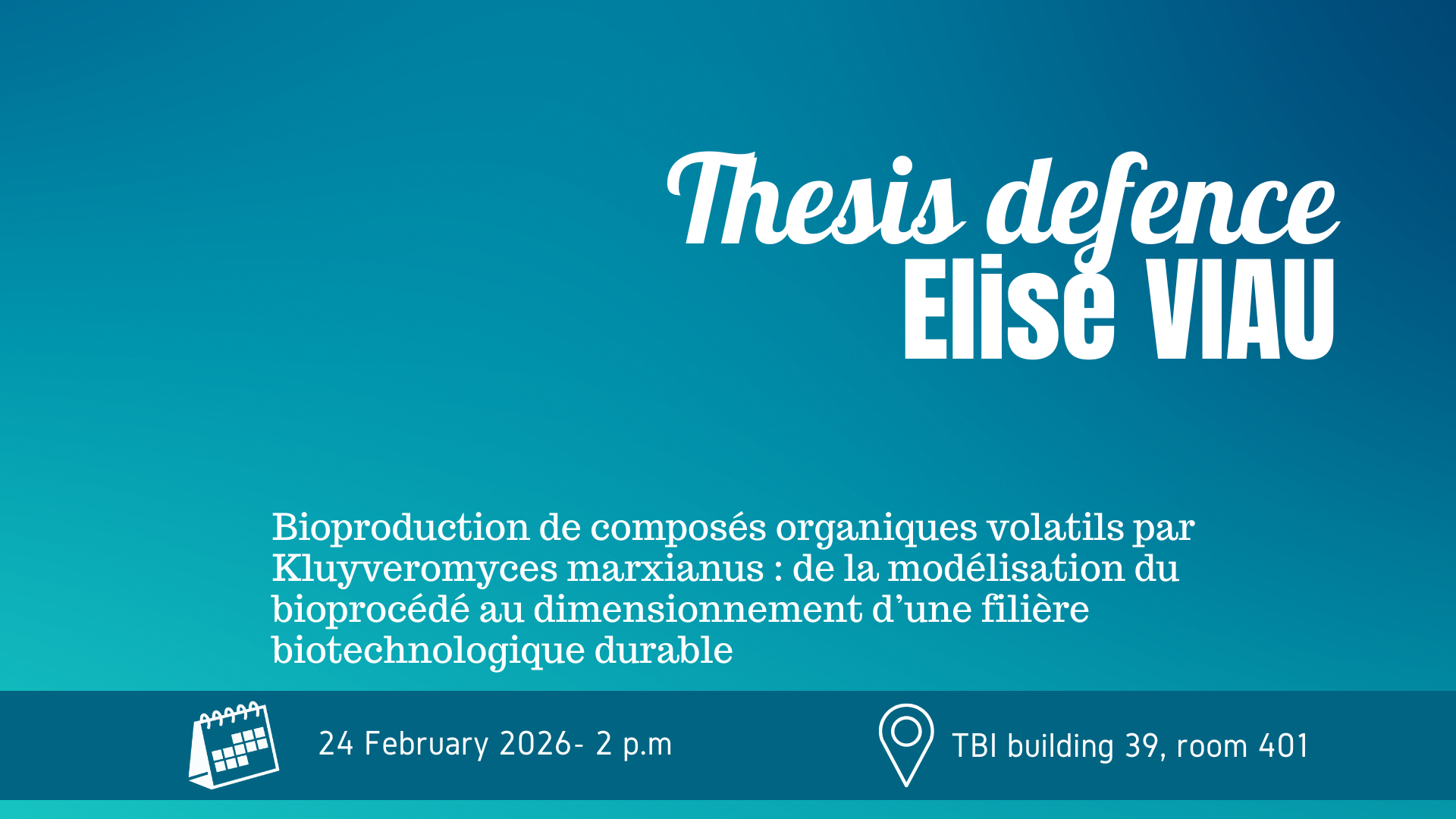
Elise VIAU soutiendra sa thèse, spécialité Ingénieries microbienne et enzymatique, sur le thème « Bioproduction de composés organiques volatils par Kluyveromyces marxianus : de la modélisation du bioprocédé au dimensionnement d’une filière biotechnologique durable », le 24 février 2026 à 14h, salle 401 à TBI.
Membres du jury : Sandrine ALFENORE, Emmanuel GUEDON, Pierre FONTANILLE, Carine BIDEAUX, Caroline SABLAYROLLES, Victor POZZOBON, Cristian TRELEA.
Abstract
This thesis was conducted within the framework of the NEW ECO‑ROUTES project (ANR‑21‑CE43‑0012‑01), which aims to develop a predictive tool for the design of sustainable bioprocesses. This tool will rely on the integration of a biological model, a model for the extraction/purification step, and an environmental analysis model. As proof of concept, the biological route for converting lignocellulosic biomass into volatile compounds, primarily ethyl acetate (EA), using the yeast Kluyveromyces marxianus was selected.
EA is currently produced almost exclusively through petrochemical routes, despite its widespread use as a solvent. Microbial production remains poorly documented, particularly from lignocellulosic substrates. The main knowledge gaps concerned the lack of quantitative data on xylose and glucose-xylose mixtures, limited information on the impact of substrate availability under iron‑limited conditions, and the absence of a stoichiometric metabolic flux analysis (MFA) model for EA biosynthesis.
The main objective of this thesis was to experimentally obtain growth, consumption, and production kinetics of K. marxianus CBS 600 cultivated on glucose and/or xylose, with a focus on iron limitation as a potential effector of EA biosynthesis. The generated data during this thesis will also support the future development of a relevant biological model for the project. Controlled bioreactor experiments enabled: (i) validation of the iron limitation threshold on glucose and on xylose, (ii) exploration of fed‑batch strategies to identify effectors of EA production, (iii) characterization of EA and xylitol dynamics on single and mixed substrates, and (iv) quantification of acetate inhibition independently of iron limitation.
Results confirmed that iron limitation triggers EA synthesis on glucose, accompanied by concomitant ethanol accumulation. Moreover, fed‑batch experiments demonstrated that iron is not the sole effector: substrate availability plays a decisive role in regulating metabolic fluxes and conditioning EA biosynthesis. For the first time, EA production by K. marxianus from xylose and glucose-xylose mixtures under iron limitation was quantified under controlled conditions. On xylose alone, EA production remained marginal and unstable, while xylitol emerged as the dominant product and a robust marker of iron stress. In mixed-substrate cultures, a diauxic pattern was confirmed and analysed: EA was mainly formed during the glucose phase, whereas xylitol was produced exclusively from xylose. The subsequent re‑consumption of EA highlights the need for an in-situ extraction strategy. Acetate inhibition was quantified separately, affecting growth and ethanol production, while EA remained unaffected.
This thesis thus clarifies the dynamics of K. marxianus on glucose and xylose substrates and identifies possible mechanisms of EA production. The work also enabled the establishment of kinetic equations related to acetate inhibition, and the generation of essential datasets for the calibration and validation of a biological model of EA production. This work contributes to the development of sustainable bioproduction chains and, within this proof of concept, positions EA and xylitol as metabolites of interest for the valorization of C6 and C5 sugars derived from lignocellulosic biomass.